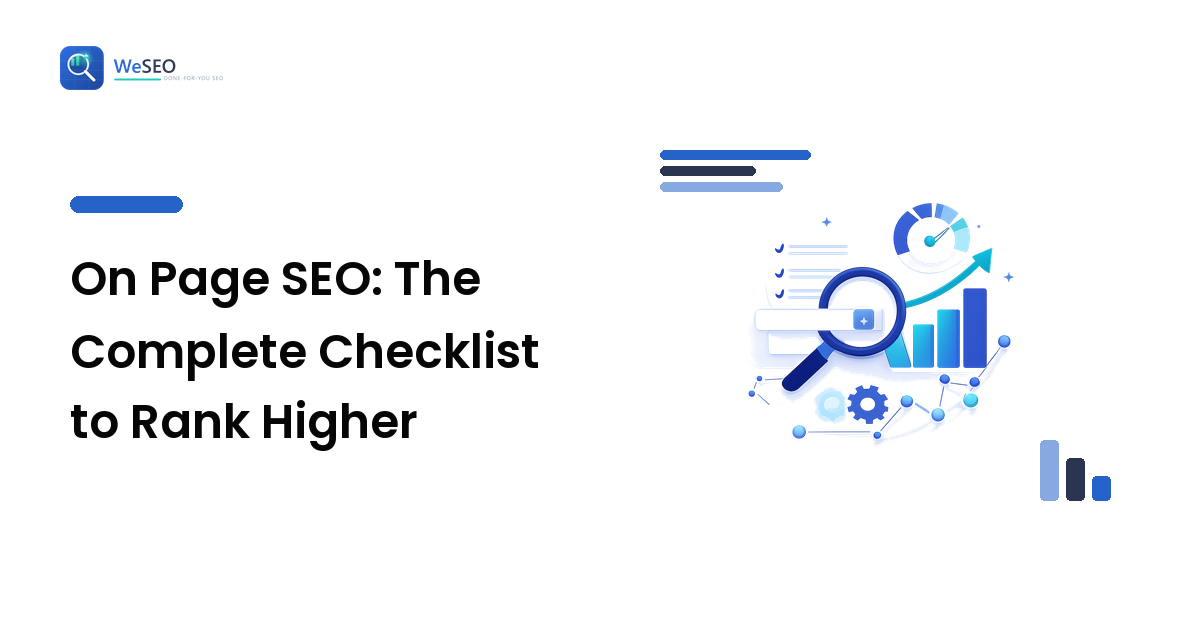
On-page SEO is everything you control on the page itself — the words, the structure, the links, and the signals that tell a search engine what the page is about and who it's for. It's the part of SEO with the fastest, most reliable payoff, because unlike chasing backlinks or waiting out an algorithm, you can sit down today and improve a page you already own.
The short version: a page ranks when it clearly matches what a searcher wanted and makes that match easy to confirm. That means picking one target search per page, satisfying its intent fully, and using titles, headings, and internal links to signal the topic — not stuffing keywords. Below is a workflow you can run on any page, plus how to measure whether it worked.
What on-page SEO actually covers
On-page SEO splits into two halves that are easy to confuse. Content is whether the page answers the search — depth, relevance, intent match. On-page technical signals are the markup and structure that help a search engine read it — the title tag, headings, URL, internal links, image alt text, and meta description. Both matter, but in that order: the best-tagged page in the world won't rank if the content doesn't match the search, while genuinely useful content can rank even with imperfect tags.
This guide is about the page itself. The wider question of which pages to build and in what order belongs to your SEO strategy — on-page work is how you execute that plan one page at a time.
Start with one search and its intent
Every page should target one primary search and the intent behind it. Trying to rank a single page for ten unrelated terms usually means it ranks well for none, because the content can't be focused enough to satisfy any of them.
Intent is the part people skip. Before writing or editing, look at what already ranks for your target term and ask what kind of page it is:
- Informational ("how does on-page SEO work") wants a guide or explainer.
- Commercial ("best seo tools") wants a comparison or roundup.
- Transactional ("hire seo agency") wants a service or product page.
If the results are all comparison posts and you publish a sales page, you'll struggle no matter how polished it is — the page doesn't match what searchers (and therefore the search engine) expect. Match the format first; optimize the details second.
Write the title and meta description for a human
The title tag is the single highest-impact on-page element, because it does two jobs: it helps a search engine understand the page, and it's the headline a searcher decides whether to click. Put the primary term near the front, keep it readable, and make it specific. "On-Page SEO: A Practical Guide to Optimizing Every Page" tells you exactly what you'll get; "SEO Tips & Tricks" tells you nothing.
The meta description doesn't directly affect rankings, but it affects clicks, and click-through is worth optimizing. Write one or two sentences that describe the value of the page and include the term naturally. Think of it as ad copy for a free listing.
A practical caution: don't write titles for robots. Cramming the keyword in three times reads as spam to people and offers no ranking benefit. One clear, compelling title beats a keyword-stuffed one every time.
Structure with headings and clean URLs
Headings (H1, H2, H3) give a page a skeleton. The H1 states the topic; H2s break it into the questions and subtopics a reader has; H3s handle detail underneath. This structure helps readers scan and helps search engines understand how the page is organized — and it's what most blog platforms use to build an automatic table of contents.
Write headings as the questions people actually ask, not as keyword labels. "How to write a title tag" is more useful than "Title Tag SEO." Keep the URL short and descriptive too — /on-page-seo-guide beats /blog/post?id=4471. You only set a URL once, so set it cleanly.
Optimize the content, not the keyword density
Old on-page advice obsessed over keyword density — hitting a magic percentage of exact-match terms. Modern search engines understand language and synonyms, so that math is obsolete and counterproductive. What helps instead:
- Cover the topic completely. Answer the obvious follow-up questions on the same page. Depth that genuinely serves the reader is the strongest content signal you have.
- Use natural language and related terms. Write the way an expert explains the topic, and the relevant vocabulary appears on its own.
- Front-load the answer. Give the key takeaway early, then expand. Readers (and search engines) reward a page that delivers quickly.
- Make it readable. Short paragraphs, lists where they fit, and plain words keep people on the page, and engagement is a quiet quality signal.
Use internal links to spread relevance
Internal links — links from one page on your site to another — are one of the most underused on-page levers. They help search engines discover pages, understand how topics relate, and pass ranking signals from strong pages to the ones you want to lift.
The practical habit: when you publish or update a page, add links from a few related pages to it using descriptive anchor text (the clickable words), and link out from it to its pillar and siblings. Anchor text like "on-page SEO" tells a search engine what the destination is about; "click here" tells it nothing. Group related articles into clusters that all link to a central pillar, and you build topical authority that individual pages can't earn alone.
A repeatable on-page workflow
Run this on any page you want to improve:
- Confirm the target search and intent. One primary term; check what format already ranks for it.
- Match the format. Make sure the page type fits the intent before touching anything else.
- Rewrite the title to lead with the term and earn the click; write a compelling meta description.
- Fix the structure. One clear H1, logical H2/H3s written as real questions, a clean URL.
- Deepen the content. Answer the follow-up questions, front-load the takeaway, cut filler.
- Add internal links in and out, with descriptive anchor text, tied to the page's cluster.
- Add alt text to meaningful images, describing them plainly.
- Re-check rankings and traffic in a few weeks and iterate.
How to choose what to optimize first
You can't redo every page at once, so sequence by payoff. The fastest wins are pages already ranking on page two: they've proven relevance and often need only a tighter intent match, a better title, or stronger internal links to break onto page one. Optimize those before writing anything new — the effort is low and the result can show in weeks, not months. Brand-new pages targeting competitive terms are worth doing, but they're the slow lane; set expectations accordingly.
How to measure on-page changes
On-page work is measurable, so measure it instead of guessing:
- Rankings for the target term — note the position before you change anything, then watch it.
- Click-through rate from search — a better title and description should lift it even before rankings move.
- Organic traffic and engagement to the page — is it rising, and are visitors staying?
Give changes a few weeks before judging them; search engines need time to recrawl and reassess. If a well-optimized page still doesn't move after a reasonable wait, the issue is usually intent mismatch or competition, not a missing tag.
FAQ
Is on-page SEO still important?
Yes. It's the part of SEO you fully control, and it's how a search engine confirms a page matches a search. Off-page signals like links matter too, but a page that doesn't match intent won't rank no matter how many links point at it.
How many keywords should one page target?
One primary search, plus the closely related terms and questions that naturally belong to it. A focused page satisfies intent better than one trying to rank for many unrelated terms at once.
Does keyword density matter anymore?
No. Modern search engines understand language and synonyms, so hitting a target percentage of exact-match terms does nothing useful and can read as spam. Cover the topic well in natural language instead.
How long until on-page changes show results?
Improvements to a page already ranking can show within a few weeks once it's recrawled. Pages need time to be reassessed, so make your changes, then check back rather than expecting instant movement.
What's the single most impactful on-page element?
The title tag, because it both signals the topic to a search engine and decides whether a human clicks. A clear, specific, intent-matched title is the highest-leverage change on most pages.
Next step
Pick one page that's stuck on page two and run the workflow on it: confirm its search intent, match the format, tighten the title and headings, deepen the content, and add internal links with real anchor text. Re-check its ranking in three weeks. If you'd rather have a team audit and optimize your pages systematically, WeSEO can turn this into steady organic growth.